Hi. I'm Wagsly.
Before the values series begins, a question worth answering first. How does a brand actually end up on Wuforia?
The brands on this site are the whole show. Every leash, every collar, every bed you'll find here arrived because somebody on our team went and found the maker, dug into their story, vetted what they do and how they do it, and came away confident in both the people behind the work and the work itself.
This is what that process actually looks like.
Start with the maker, not the product.
The pet industry has more product in it than ever. Many of those products are fine. Some are even good. But "fine" and "good" don't get a brand into a lineup like Wuforia. What gets you here is being made by a person we believe in, in a way we can verify, for a reason that holds up under questioning, with work that earns our confidence on its own.
That's how we sort.
When a brand crosses our path, whether through Faire, a tip from another founder, or a customer asking us to please carry them, we start with the people behind it. Who started this? When? Where do they make it? What problem were they trying to solve? Thin answers tend to stop the conversation. Real answers (a name, a year, a place, a problem) earn the next one, and the one after that.
But the About page is the front door, not the whole house. Once a brand has cleared that first filter, the rest of the process is about getting to know the product the way you'd get to know a craftsperson's work. Slowly, from a few different angles, before we'd ever stand behind it to a friend.
What we actually look at.
Four signals we look for:
A founder whose story you could repeat from memory after one read
Take Alisha Navarro. In 2003, she had $500, a sewing machine, and a spare room in Indian Trail, North Carolina. From that room, she built what is now 2 Hounds Design: a 20,000-square-foot workshop with more than 50 craftspeople and a patented Freedom No-Pull Harness that shelter workers around the world use to walk dogs that would otherwise be unwalkable. Inc 5000 noticed her years ago. Twenty-plus years on, she still runs the company.
You can pick up the 2 Hounds Design story in a sentence and tell a friend over coffee. Founders with stories you can hold in your head usually have built companies you can trust your dog to.
A way of making that you can see in the finished thing
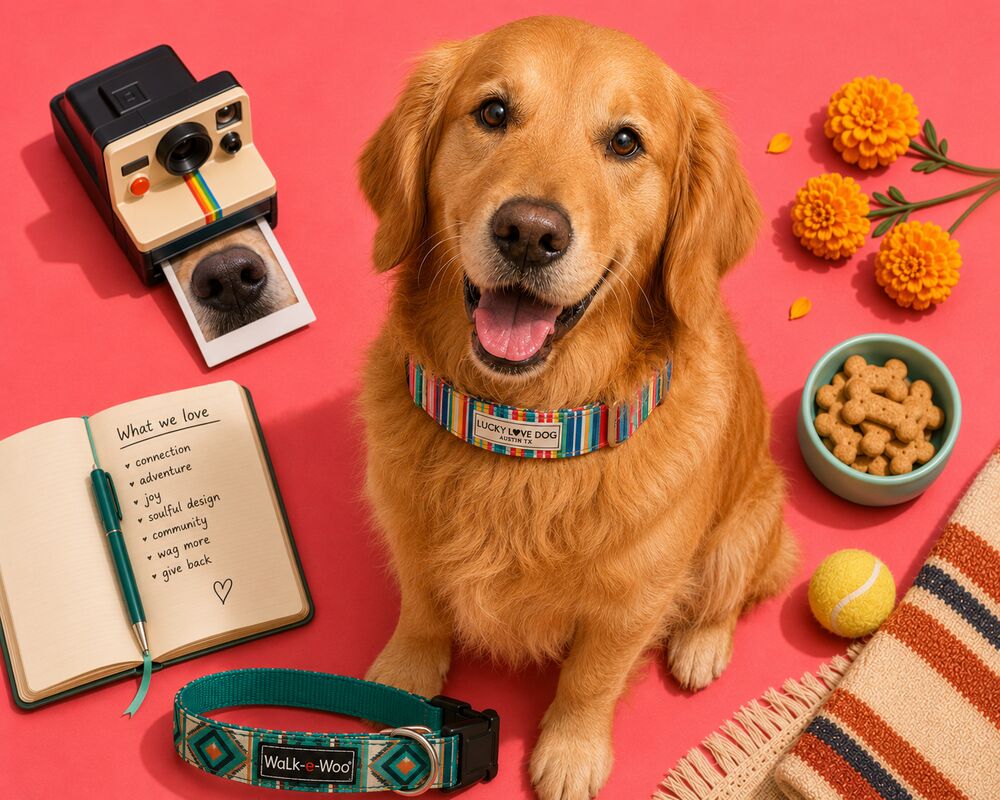
Wendy Jones started WaLk-e-Woo in 2002 in Denver, Colorado. More than twenty years in, the studio is still on the Front Range. The webbing is custom-printed in small runs, the hardware is solid brass, and several of the original patterns from the early 2000s are still in the active line.
That kind of detail tells you a brand isn't churning out the same nylon strap with a new label every season. Custom webbing means small enough to control the runs. The brass hardware is heavier than the cheap stamped stuff and will outlast a decade of leashings. As for those original patterns still selling, that tells you the design instincts were right the first time.
A point of view you can verify by looking at the company over time
Amy Metz-Stanton founded LuckyLoveDog in Austin, Texas while also co-founding Addicus' Legacy Dog Rescue, where she still serves as director. The rescue has pulled more than 5,200 dogs off the streets across Texas, Mexico, and Thailand. The brand and the rescue have always operated as two halves of the same commitment: every embroidered collar, leash, and bandana that goes out the door feeds back into the operation that gets dogs into homes.
In LuckyLoveDog's most recent year, that loop returned roughly $82,000 to the rescue.
That's a point of view you can verify by tracing the brand's whole structure. The rescue isn't a marketing partner LuckyLoveDog donates to. Amy was already running it when she started making collars. The brand exists to fund the work she was already doing. The whole thing reads as a love letter to rescue dogs and the households who took them in, written one stitch at a time.
A product we've come to feel confident in
This is the one that's hardest to put on a clean checklist, and the one that matters most. Underneath the founder vetting, the making, and the values, there's a fourth thing: the confidence we've come to feel about the product itself.
That confidence gets built in a few different ways depending on the brand. For some, it's built over years of watching a maker's reviews stack up across every channel they sell in. For others, the work has landed in our hands and outlasted the season. Some came in on the off-the-record word of a peer in the industry telling us this brand is the real deal, and that hint turning into a long-running fit. Most are some mix of all three.
However that confidence gets built, by the time a brand is on Wuforia, the product has earned its place. The story behind it is only half of the work.
How values work here.
A lot of stores treat values like garnish. They add a small badge to the product page that says Female-Founded or Eco-Friendly and call the day done. We treat them differently.
The values you'll see across this site (Female-Founded, Family-Owned, Made in USA, Heritage Brand, Handmade, Eco-Friendly, Organic, Gives Back, Asian-Owned, Latino-Owned) are how we sort the candidates before we ever write a product description. When we say a brand is Female-Founded, it's because we know her. Heritage Brand means they were making things before any of us were born. For Gives Back, there's a partner and a number we could point you to.
That's the structural choice. We built the site to filter on values because that's how we slice the catalog ourselves.
What's in the rest of this series
The posts that follow walk through the values one at a time. Female-founded first. More brands fall there than anywhere else. Family-owned next. Made in USA and the heritage names. The handmade makers. The brands that give back. We close with the smaller partnerships in the lineup, including the AAPI- and Latino-owned brands we feel especially lucky to carry.
If you've ever wondered why a curated dog store would lead with stories before specs, the rest of this series is the answer. (And yes, I'll be popping in along the way. I have opinions about most of them.)
Wags & wufs,
Wagsly